
Types of Mobile Cranes: How They Work and Which One Fits Your Job
Ask five contractors what crane they need and you may get five different answers, and all five could be right. There is no single “crane,” just a family of machines built for different ground and different lifts.
This guide covers how a crane works, the main types, and how to match one to your job.
How a Crane Works
Every crane runs on the same handful of parts.
The boom is the long arm that lifts and moves the load. A telescopic boom slides sections in and out, like a fishing rod, and sets up fast. A lattice boom is a truss of webbed steel, assembled on site, that usually lifts more and reaches higher in exchange for a longer setup. Hiab’s breakdown of how a crane boom works (opens in a new tab) covers both designs.
The hydraulic system moves fluid through pumps, hoses, and cylinders to extend the boom, raise the load, and steer the outriggers, holding everything steady under constant pressure.
Outriggers and counterweight widen the crane’s base and balance the load, letting a mobile crane lift far more than its own weight without tipping.
The load moment indicator is a computer that tracks boom angle, length, and load weight, warning the operator before the crane gets close to tipping.
The Main Types of Cranes
The types below are different combinations of those parts, built for different ground. OSHA’s scope for its crane and derrick standard (opens in a new tab) covers most of them as established equipment categories.
All Terrain Crane
An all terrain crane rides on a wheeled carrier with 4 to 9 axles and runs two engines, one for the carrier and one for the crane. An all terrain mobile crane can drive itself on the highway, then set up and lift on rough ground once it arrives. Capacity runs from about 35 tons on the smallest models past 400 tons on the largest.
Best for jobs that move between sites often. See our used all terrain crane buying guide and all terrain crane inspection guide for a deeper look.
Rough Terrain Crane
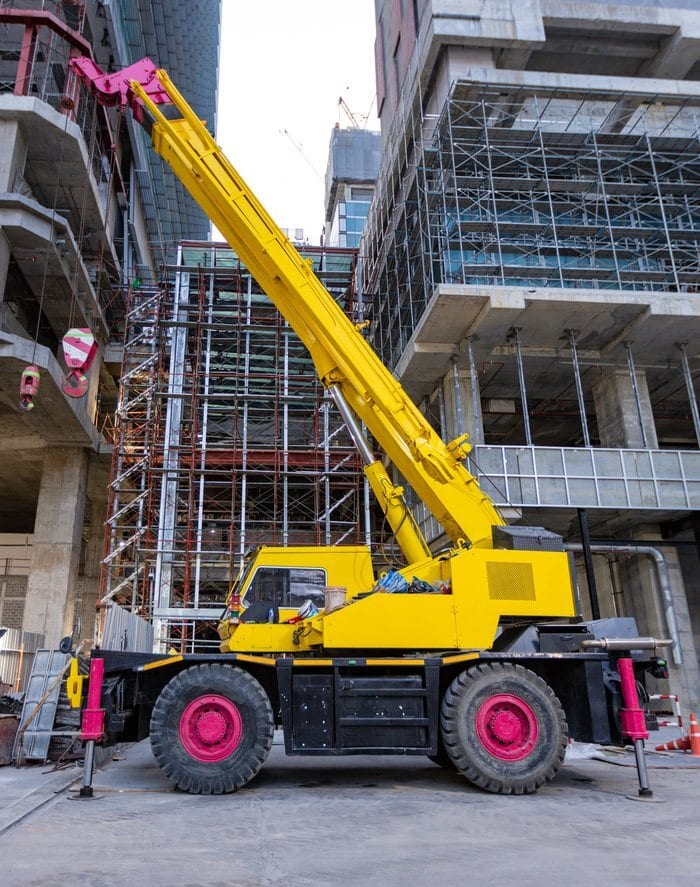
A rough terrain crane is built for the job site, not the highway. It rides on large, off-road tires, runs a single engine, and has to be hauled in on a trailer. In exchange, it works all day on soft or uneven ground where an all terrain crane’s carrier would struggle.
Best for single job sites with rough or muddy ground. Rough terrain cranes overlap the smaller and mid-size all terrain cranes on capacity but do not reach the largest models.
Truck Mounted Crane (Boom Truck)
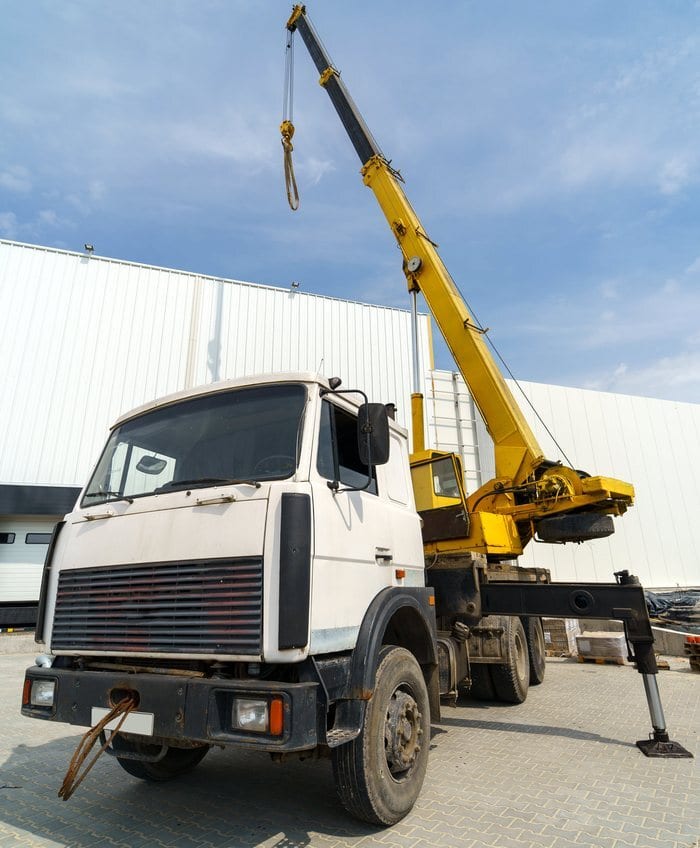
A truck mounted crane, often called a boom truck or crane truck, bolts a hydraulic boom onto a standard truck chassis. It drives itself to the job at highway speed but trades off-road capability and heavy lifting for speed. Some smaller models are built as a truck bed crane mounted on a pickup or utility truck, sitting at the low end of the market.
Best for light to mid-capacity lifts that move fast between jobs in a day.
Crawler Crane
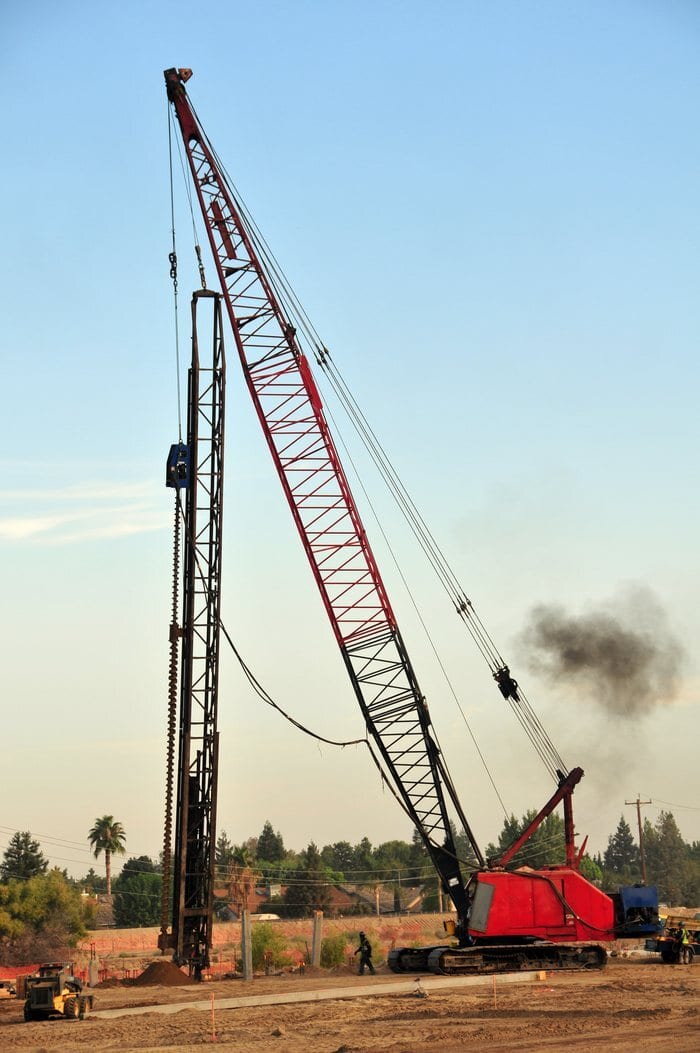
A crawler crane trades wheels for tracks, giving it a wider footprint, better ground pressure, and, on some models, the ability to lift while moving. The tradeoff: it cannot drive between sites and must be broken down and hauled on multiple trucks.
Most run a lattice boom for maximum capacity and reach. Others use a telescopic boom for faster setup on smaller jobs. Builders reach for this type on high-rise, bridge, and heavy industrial work where nothing else lifts enough.
Best for heavy, long-duration lifts where ground rules out a wheeled crane.
Smaller Cranes (Carry Deck, Spider & Mini)
This last group is not one type but three related designs, all built for tight or indoor work rather than a specific travel style.
A carry deck crane puts a rotating boom on a low, four-wheeled deck. Unlike the other types here, it can pick up a load and carry it across a site, not just set it back down. Most top out around 25 tons.
A spider crane sits on a small crawler carrier with spider-like outriggers, working in tight spaces and even as an indoor crane, often with remote-control operation. Mini crane is the umbrella term for this whole compact class, covering spider cranes plus other small wheeled and crawler models built for doorways and confined sites.
Best for indoor work and tight urban sites.
Crane Comparison at a Glance
| Type | Travels On | Typical Capacity | Best For |
|---|---|---|---|
| All Terrain Crane | Highway + rough ground, own power | 35 to 400+ tons | Multi-site jobs |
| Rough Terrain Crane | Off-road only, trailer | 30 to 130 tons | Rough or soft ground, one site |
| Truck Mounted Crane | Highway, own power | 3 to 40 tons | Fast, light to mid-capacity lifts |
| Crawler Crane | Tracks, multiple trucks | 40 to 2,500+ tons | Heavy, long-duration lifts |
| Smaller Cranes (Carry Deck, Spider, Mini) | Trailer, short distances | Up to 25 tons | Indoor and tight urban sites |
How to Choose the Right Crane for Your Job
Match the crane to the work you actually run, not the one big job you might take on someday.
- Heaviest regular lift? Size to your typical week, not your biggest possible day.
- One site or many? Moving often rules out crawler and rough terrain cranes.
- Ground conditions? Paved favors a truck mounted or all terrain crane. Rough or muddy favors a rough terrain or crawler crane.
- Tight or indoor space? Look at a carry deck, spider, or mini crane.
- Ongoing use or one job? Frequent use favors buying. A short crane rental often beats a purchase.
Getting crane sizes right the first time saves money on fuel, transport, and permits for the life of the machine.
Now that you know the types, browse our current crane inventory or read our used all terrain crane buying guide for a closer look at one. Financing options are available through Equify Financial when you are ready to buy.
Frequently Asked Questions
What is a boom truck?
A boom truck, also called a truck mounted crane or crane truck, is a hydraulic boom mounted on a standard truck chassis. It drives itself to the job and handles lighter, faster lifts, not heavy industrial work.
What is a crawler crane?
A crawler crane moves on tracks instead of wheels. It cannot travel on public roads and has to be hauled to the site, but it carries heavier loads on rougher ground than most wheeled cranes.
Which cranes use a lattice boom?
Crawler cranes and larger all terrain cranes use it most often, since a lattice boom gives the reach and capacity for the heaviest lifts.
How much does a crane cost?
It depends on type and capacity. A small truck mounted or carry deck crane can run under $100,000 used. A large all terrain or crawler crane can run past $1,000,000.
Ready to find your machine?